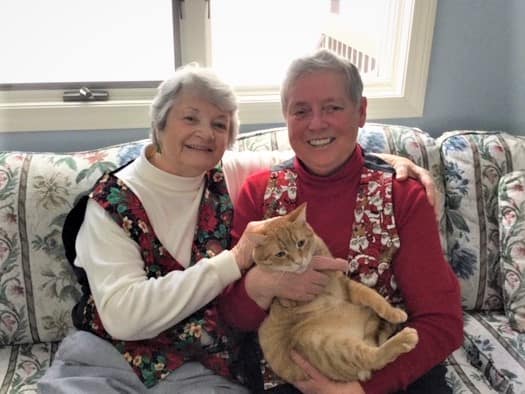
For a little over a decade, I was the communications missioner for the Episcopal Diocese of Western Massachusetts. I wrote stories for and designed its magazine and monthly newsletter, and, when needed, I sent press releases to media outlets in the region. I loved the people I met at the Diocese, and they are still kind to me. Last year, they referred author Patricia O’Connell to me.
Pat was working on a book, “We Called Him Al,” about the loss of her wife, Vivian, and she needed help with editing, design, and production. The book is thoughtful, evocative, and beautiful. Pat’s niece designed the warm and inviting cover.
Pat was introspective and responsive, so working with her was a pleasure, and I have heard great feedback from people who have read her story, which offers an invitation for readers to journey with Pat and Vivian through the great medical challenge that is Alzheimer’s disease. Using poetry and prose, Vivian’s story of the last twenty-eight months of her life unfolds as a prayer more than a memoir. For those souls afflicted with Alzheimer’s and the loved ones who care for them, “We Called Him Al” is the voice of faith and hope, asserting that love is stronger than death.
Pat is a wonderful writer. Every day, she writes a reflection for the Diocese, called Deacon Pat “Unplugged.” Writing it is part of Pat’s morning routine; reading it is part of mine. Like her book, the messages are hopeful, compassionate, and clear and simple. My nephew Brendon Beetle interviewed Pat for the below story; it is the first of two parts.
What inspired you to write a memoir?
It wasn’t that I was trying to write a memoir. For most of my life, I kept journals and they helped me keep myself grounded and centered in different situations. I cared for my wife who had Alzheimer’s. It was a twenty-four/seven job as her cognitive abilities diminished. I began to realize that I should put our story into book form.
What was your goal in publishing?
Sharing an experience that could be helpful for others going through similar situations.
How would you describe your book?
It’s poems. It’s memories, and it’s a reflection on a difficult time in which my wife and I both tried to make the best of a sad situation and find both joy and sorrow while reflecting on the good times. It isn’t meant to be read front to back, and it doesn’t have to be read in order. It is a reflective experience no matter where you begin.
How did writing this memoir help you better understand your grief?
I had no idea that publishing the book—taking everything I had and putting it into book form over a couple of years—would actually become a part of the grief process. I was able to work through the grief while building this book. Janice and I would talk about the book, and I never really appreciated how much it helped me through that tough time. I suspect now Janice understood that.
What do you hope people will take away from reading your book?
I hope people who read it can find a sense of peace and connect with their own center after reading and reflecting on things I went through. I want people to be able to get in touch with their own feelings and make it personal for them.
Were there any resources or references that were helpful in writing your memoir?
I do a prayer blog every morning. It’s fresh every day. I write whatever I feel inspired by, and it helped me keep focused and centered throughout this process. Obviously, my faith helped too; without it, I could never have gone through that experience and stuck with it. As dark as it all seems, there is a light.
What suggestions do you have for someone writing a memoir who doesn’t know where to start?
Get an editor like I did. Lol. Trust your own experience. I was guided by the Holy Spirit—that’s what it was all about. Because I was writing in a journal format, I already had that day-by-day structure in place. Janice came in and helped me fill in the holes. I’d be talking about a certain moment, and she’d help me set up the details.
What was the editing and publishing process like for you?
Early on, I asked a couple of authors for advice. What happened was one author started reading my work and wanted to write it for me, and another thought it needed to be a novel. That is not what I wanted. I wanted it to be reflective. I wanted what Janice helped me create—a book that was reflective, not just a good read.
How did your work with Janice enhance your book?
She understood my goal from the beginning, saw my vision, and helped take it to the point where I could get my thoughts on paper.
What else would you like readers to know about the initial work of publishing a book?
It’s hard. Don’t have any illusions. You can’t publish just anything you write.
Leave a Reply